Missing Tooth Replacement in Sydney — Every Option, Compared Honestly
A gap in your smile has more than one fix. The main ways to replace a missing tooth are a
dental implant, a dental bridge or a partial denture —
and the right one depends on where the gap is, the health of the teeth beside it, your bone, your budget
and your timeline. This page lays out every option side by side, in plain English, so you can walk into
your consultation already knowing what to ask.
Every option explained before you decideGentle with nervous patientsEnglish & Mandarin
⭐ 4.9-star Google rating, 216+ reviews🦷 Implants, bridges & dentures under one roof🧾 Fixed written quote before treatment💳 Payment plans & early super access
The short answer
What Are the Options for Replacing a Missing Tooth?
There are five main options for missing teeth in Australia — whether you need a single tooth replacement or several:
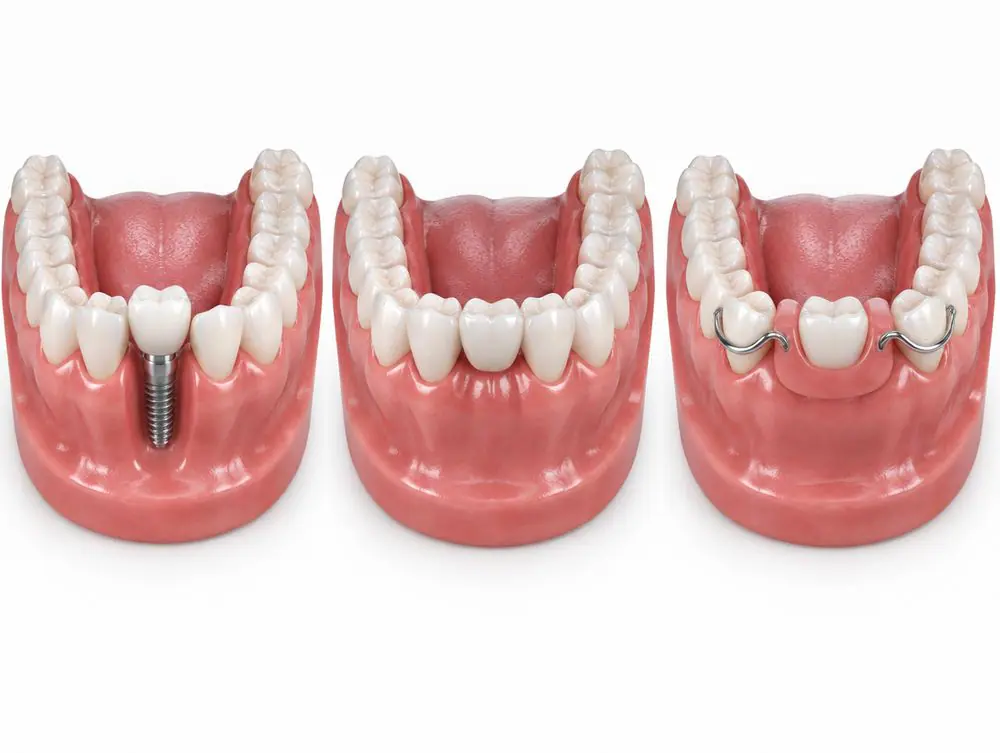
Dental implant — a titanium root placed in the jawbone with a crown on top. The longest-lasting, most natural-feeling option and the only one that doesn't rely on neighbouring teeth. From $4,500 at Midas Dental.
Conventional dental bridge — a false tooth held by crowns on the teeth either side. Fixed, fast (about 2–3 weeks) and no surgery, but the neighbouring teeth are reshaped.
Maryland (resin-bonded) bridge — a false tooth with small wings bonded to the back of the neighbouring teeth. Minimal drilling; best for a single missing front tooth.
Partial denture — a removable plate carrying one or more false teeth. The lowest upfront cost and no surgery, but it comes out for cleaning and is the least stable.
Implant bridge or full-arch implants (e.g. All-on-4) — for several missing teeth in a row, or a whole arch: a few implants support a fixed bridge.
Implant · bridge · partial denture — the three most common ways to fill one gap (illustration)
For most healthy adults, a dental implant is the long-term gold standard; a bridge suits people who want a
fixed tooth without surgery; a partial denture suits tight budgets or several gaps. Payment plans and early release of superannuation can
help spread the cost. The right choice is confirmed with an examination and x-rays — Midas Dental,
Erskineville, Sydney · (02) 9068 1388.
30-second option finder
Which Missing Tooth Solution Fits You?
Three taps, and we'll show you the option most people in your situation end up choosing — and the one worth comparing it with.
Side by side
Tooth Replacement Options Compared
The same five questions decide every case: how long it lasts, whether it's fixed or removable, whether
it touches your healthy teeth, how long it takes, and what it costs. Here's how each option answers them.
Temporary teeth soon after surgery; final bridge ~3–6 months
$17,999 / arch
*Implant fixtures commonly last decades with good care; crowns and bridge teeth may need replacing over time.
Lifespans are typical ranges, not guarantees. Prices are indicative "from" guides for straightforward cases,
last reviewed September 2026 — your exact figure comes in a fixed, itemised written quote after your
examination, before any treatment starts. Payment plans and early super access are available (see how).
Each option in plain English
How Each Missing Tooth Replacement Works
What it is, who it suits, and the honest trade-offs — the conversation you'd have in the chair, written down.
The implant replaces the root; the crown replaces the part you see. Neighbouring teeth untouched.
Option 1 · The long-term gold standard
Dental Implant: A Brand-New Tooth, Root and All
A dental implant
replaces the whole tooth — not just the part you see. A small titanium post is placed in the jawbone where the
root used to be; over about three months the bone bonds to it (osseointegration). A custom crown is then fixed
on top. It's cleaned like a normal tooth, you chew on it like a normal tooth, and because it stands on its own,
the healthy teeth beside it are never drilled. It's also the only option that keeps stimulating the jawbone,
which slows the bone shrinkage that follows tooth loss.
Best for: anyone with good general health who wants the most natural, longest-lasting fix — especially when the neighbouring teeth are healthy and unfilled.
The two neighbouring teeth are shaped to take crowns; the false tooth in the middle spans the gap.
Option 2 · Fixed, fast, no surgery
Conventional Dental Bridge: Borrowing Strength from the Teeth Beside the Gap
A bridge is a single piece: a false tooth (the pontic) joined to crowns that fit over the teeth on either side
of the gap. Those neighbouring teeth are reshaped to take the crowns, and the whole bridge is cemented in — it
doesn't come out. There's no surgery and it's usually finished in two visits a couple of weeks apart. It's an
excellent choice when the neighbouring teeth already have large fillings or crowns, because crowning them does
double duty.
Lasts10–15 years
Time2–3 weeks
Visits2
From$3,500
Pros
Fixed — never comes out
No surgery, no healing wait
Natural look in porcelain or zirconia
Cons
Healthy neighbouring teeth are reshaped
Needs a floss threader to clean under
Bone under the gap keeps shrinking
If one supporting tooth fails, the bridge is redone
Best for: one missing tooth (or two) where the teeth either side already need crowns, or when surgery isn't an option.
Viewed from behind: slim wings bond to the back of the neighbouring teeth. The fronts stay untouched.
Option 3 · Minimal drilling
Maryland Bridge: The Conservative Fix for a Missing Front Tooth
A Maryland (resin-bonded) bridge is a false tooth with slim wings that are bonded to the tongue-side of the
neighbouring teeth. Little or no drilling is needed, so the front of your natural teeth is left alone. It's a
popular solution for a single missing front tooth — including for younger adults who aren't ready for an
implant yet — and it's quick to fit. The trade-off is strength: it's held by bonding rather than crowns, so it
suits front teeth rather than heavy-chewing back teeth, and it can occasionally come unstuck and need re-bonding.
Lasts5–10+ years
Time1–2 weeks
Visits2
From$2,500
Pros
Little to no drilling of healthy teeth
No surgery
Fast and relatively affordable
Cons
Not for back teeth or heavy bites
Can debond and need re-cementing
Metal wings can slightly grey thin teeth (ceramic options help)
Best for: a single missing front tooth with healthy neighbours and a normal bite — or a long-term "bridge" to a future implant.
A cobalt-chrome partial: thin metal framework, clasps that hold onto your own teeth, false teeth on a gum-coloured base.
Option 4 · Lowest upfront cost
Partial Denture: Removable Teeth That Fill One Gap or Many
A partial denture is a custom plate that
carries one or more false teeth and clips onto your remaining teeth. It's the most affordable way to replace
missing teeth — especially when there are several gaps in different places, because one denture fills them all.
There are three main types: acrylic (most affordable, often used as a first or interim denture),
flexible nylon (Valplast-style, gum-coloured clasps, comfortable) and cobalt-chrome
(a thin, strong metal framework — the most durable and least bulky). You take it out to clean it and usually at night.
Lasts5–10 years
Time2–4 weeks
Visits3–5
From$900
Pros
Lowest upfront cost
One appliance fills several gaps
No surgery; easy to add a tooth later
Often rebated by health funds
Cons
Removable — comes out to clean
Can move a little when eating or talking
Takes a few weeks to get used to
Needs relines as your gums change
Best for: several missing teeth in different places, tighter budgets, or anyone who wants to avoid surgery and drilling.
Two implants carry three teeth — no natural teeth are involved.
Option 5 · Several teeth in a row
Implant Bridge: Three Teeth on Two Implants
When two, three or four teeth are missing side by side, you don't need an implant for every tooth. Two implants
can support a fixed bridge that spans the whole gap — fewer surgical sites and a lower total cost than individual
implants, with the same stability and no reliance on natural teeth. It's the go-to option for a row of missing
back teeth that a partial denture would otherwise have to cover.
Lasts20+ years
Time3–6 months
Visits3–5
From$8,000
Best for: 2–4 missing teeth in a row, when you want fixed teeth without crowning healthy neighbours.
All-on-4: four implants — the back two angled to use the strongest bone — hold a full fixed arch.
Option 6 · Most or all teeth in a jaw
All-on-4 & Implant-Supported Dentures: When Many Teeth Are Missing
If most or all of the teeth in a jaw are missing or failing, replacing them one by one rarely makes sense.
All-on-4
uses four implants — the back two angled to make the most of the available bone, often avoiding grafting — to
support a complete fixed arch of teeth that doesn't come out. A temporary fixed bridge is usually fitted soon
after surgery, and the final bridge follows once healing is complete. Alternatively, an
implant-retained (snap-on) denture clips onto two to four implants: far more secure than a
conventional denture, at a lower cost than a fixed arch.
Lasts20+ years
Fixed?Yes (All-on-4)
Snap-on dentureFrom $12,000
All-on-4From $17,999
Best for: people missing most teeth in a jaw, or tired of a loose full denture. See our All-on-4 Sydney page for the full picture.
The goal isn't a tooth. It's forgetting there was ever a gap.Eat what you like, laugh without thinking about it, stop angling your smile in photos.
Is it OK to leave a gap?
What Happens If You Don't Replace a Missing Tooth?
Sometimes nothing dramatic — at first. A missing wisdom tooth or a gap at the very back may never need
replacing, and that's a conversation worth having honestly. But for most gaps, the mouth slowly rearranges
itself around the space:
Neighbouring teeth tilt and drift into the gap, opening spaces that trap food and make cleaning harder.
The opposite tooth over-erupts — it grows down (or up) into the empty space because nothing stops it.
Jawbone shrinks where the root used to be — fastest in the first year — which can make a future implant harder.
Your bite changes, loading other teeth more heavily and sometimes contributing to jaw discomfort.
Chewing moves to one side, and a missing front tooth can affect speech and confidence.
None of this happens overnight, and none of it hurts — which is why it's easy to put off. The earlier a gap is
assessed, the more options stay on the table.
Left alone: the back tooth tilts in, the upper tooth drops into the space, and the bone under the gap dips.
Where the gap is changes the answer
Missing Front Tooth vs Missing Back Tooth
Missing front tooth
Appearance leads. The gum shape around the new tooth matters as much as the tooth itself, so planning is careful. Implants give the most natural result; a Maryland bridge is the conservative fix when the neighbours are healthy.
If a tooth is cracked, loose or failing, plan the replacement before the extraction. Sometimes an implant can be placed at the same visit, or the socket preserved with a graft so the bone doesn't shrink.
Gap you've had for years?
Still very fixable. After a long time the bone and neighbouring teeth may have shifted, so x-rays (and a 3D scan for implants) show what's possible — often more than people expect.
Price guide
How Much Does It Cost to Replace a Missing Tooth in Sydney?
The cheapest way to replace a missing tooth is usually a partial denture; the best long-term value is usually an
implant, because it rarely needs redoing. As a guide at Midas Dental:
Single dental implantImplant, abutment and crown — straightforward case
From $4,500
Conventional 3-unit bridgeFalse tooth + two crowns on the neighbouring teeth
From $3,500
Maryland (resin-bonded) bridgeSingle front tooth, bonded wings
From $2,500
Partial dentureAcrylic from $900 · flexible from $1,300 · cobalt-chrome from $1,700
From $900
Implant bridgeTwo implants supporting three teeth
From $8,000
Implant-retained (snap-on) dentureA denture that clips onto implants, per arch
From $12,000
All-on-4 full archFour implants + fixed bridge, per arch
From $17,999
Indicative guides only, last reviewed September 2026. What moves the price: whether a bone graft or extraction is
needed, the crown material, and how many teeth are involved. You receive a fixed, itemised written quote before
anything starts. Full detail:
dental implant cost guide ·
denture cost guide.
Three Ways to Make It Affordable
Spread the cost
Payment Plans
Split your treatment into manageable instalments with National Dental Plan (Humm), Zip Pay, Zip Money or Afterpay, subject to provider approval and limits.
Superannuation can be used to pay for essential dental treatment — including implants, bridges and
dentures — under the ATO's Compassionate Release of Superannuation program, for
treatment that relieves acute or chronic pain or restores function.
Our team helps you apply in-house — we prepare the treatment plan, quote and dental report the application needs
The application is lodged online with the ATO through myGov
Eligibility is decided by the ATO — ask us and we'll help you check before you start
Claim on the spot
Health Fund Rebates
Extras policies with major dental cover typically rebate part of bridges, dentures and implants. We give you the item numbers upfront so you can check your rebate, and claim on the spot with HICAPS — all funds accepted.
Now dental treatment is easy
Payment Plans
Easy payment options for a hassle-free treatment — split your cost into manageable instalments.
Zip Pay
Afterpay
Zip Money
Humm
We Accept All Health Funds
HICAPS on the spot — claim your health fund rebate at the desk and pay only the gap.
How we help you decide
Implant, Bridge or Denture? The Five Things That Decide It
1
Your neighbouring teeth
Healthy, unfilled neighbours favour an implant or Maryland bridge. Heavily filled ones make a conventional bridge more attractive.
2
Your bone and gums
Implants need enough healthy bone and gums free of active gum disease. We check both before recommending anything.
3
Your general health
Smoking and uncontrolled diabetes affect healing. They don't always rule implants out, but they change the plan.
4
Budget vs lifetime cost
A denture costs least today; an implant often costs least over 20 years. We show you both numbers — and how payment plans or early super access could help.
5
Your timeline
A wedding next month? A bridge might come first and an implant later. Plans can be staged.
✓
Your call, no pressure
We explain every option that genuinely suits you — including the cheaper ones — and you decide in your own time.
What your first visit looks like
From "I Have a Gap" to a Plan You're Comfortable With
1
Send an enquiry or call
Tell us what bothers you — looks, chewing, a loose partial. We call back at a time that suits and find you a consultation time.
2
Examination & imaging
We check the teeth either side, your gums and bite, with x-rays — and a 3D scan if an implant is on the table.
3
Your options, side by side
Every option that suits you, with pros, cons and a fixed written quote for each. Nothing is booked unless you want it.
4
Treatment, gently
Numb before anything happens, breaks whenever you need them. For All-on-4, fixed temporary teeth are fitted soon after surgery.
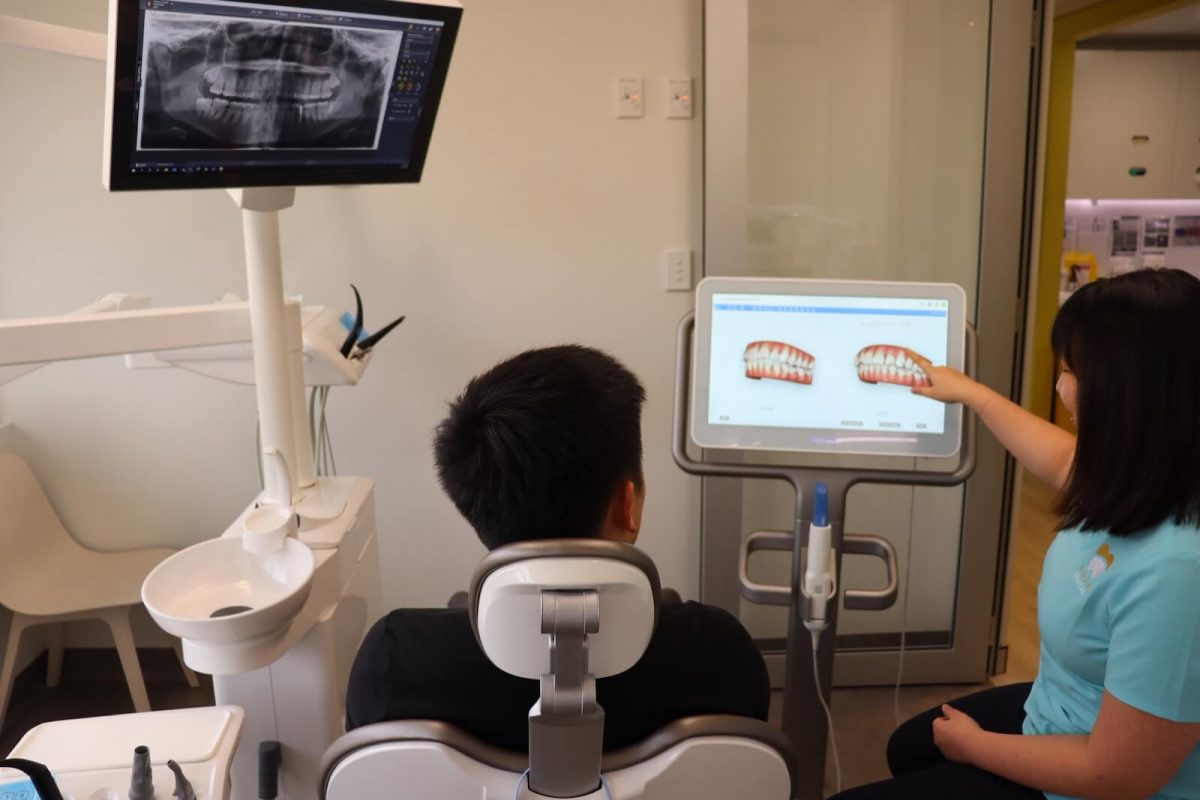
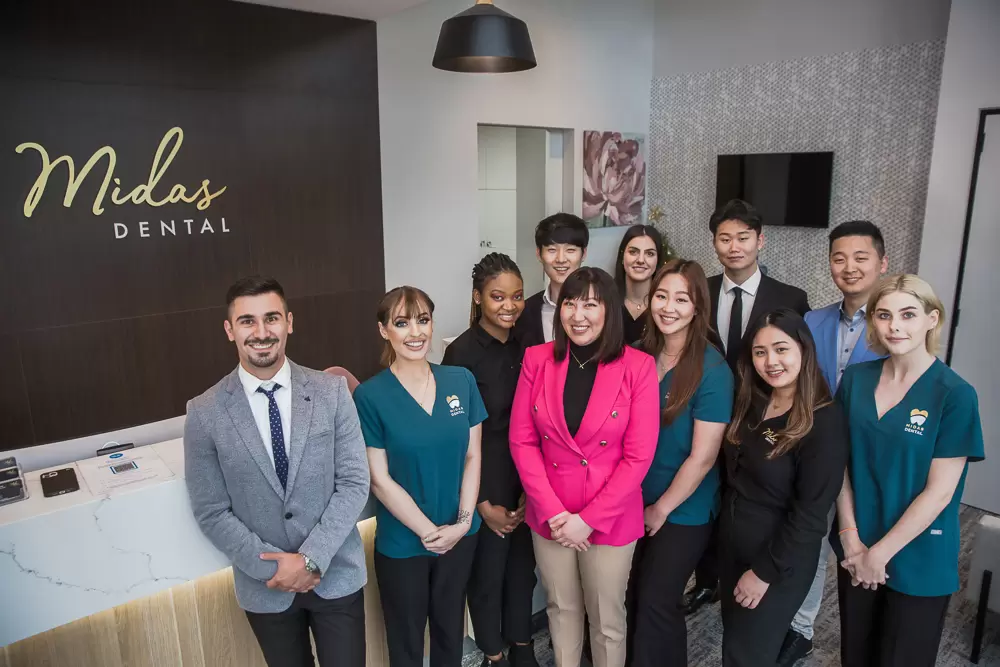
Every option explained on screen before you decide anythingThe Midas Dental team, Park Sydney Village, Erskineville
Who you'll see
Every Missing Tooth Option, Under One Roof, with Dr Katrina Zhao
Many patients come to us after being offered just one option somewhere else. At Midas Dental, implants,
bridges and dentures are all planned and provided in-house by Dr Katrina Zhao and our team —
so the recommendation you get is about your mouth, not about what one clinic happens to offer. Implant cases
use MIS or Nobel Biocare implant systems and are planned on 3D imaging.
Dr Zhao founded Midas Dental in 2019 and is known for being gentle with nervous patients: numb before anything
happens, everything explained first, and consultations in English or Mandarin.
BDS — University of AdelaideAHPRA reg. DEN0001992179MIS & Nobel Biocare implants4.9★ · 216+ Google reviews
"Absolutely thrilled with my smile makeover at Midas Dental! … The clinic is conveniently located right near Alexandria, and the whole process—from the initial 3D scans to the final result—was seamless."
Xuejiao Yao
Google Review
"I came across Midas Dental from a few recommendations and was very impressed with the service provided by Dr. Katrina and her team. I found her pricing to be fair, didn't feel rushed and the work completed was all to a very high standard."
James Norquay
Google Review
"I recently visited Midas Dental in Erskineville for a general dental check-up and clean, and I couldn't be happier with the experience. The clinic at Park Sydney Village is modern, spotless, and incredibly welcoming."
Platy
Google Review
Missing tooth solution near me
Replacing Missing Teeth for Patients Across Sydney's Inner West & Inner South
Midas Dental is at Shop 5C, Park Sydney Village, 149-153 Mitchell Rd, Erskineville NSW 2043 —
8 minutes' walk from Erskineville Station, about 10 minutes by train from Central, with the 370 bus at the door and
free underground parking (enter via Foundry St). Open Monday–Friday 9:30am–6pm and Saturday
9am–3pm. Patients come to us for missing tooth replacement from:
Questions People Ask About Replacing a Missing Tooth
For most healthy adults, a dental implant is the best long-term way to replace a missing tooth: it replaces the root as well as the crown, doesn't rely on the neighbouring teeth, helps preserve jawbone and commonly lasts decades. A bridge is a good fixed alternative without surgery, especially when the teeth either side already need crowns, and a partial denture is the most affordable option. The right choice depends on your bone, gums, neighbouring teeth, budget and timeline, confirmed at an examination.
A removable partial denture is usually the cheapest way to replace a missing tooth — at Midas Dental an acrylic partial starts from around $900. Over 15–20 years an implant can work out better value, because dentures and bridges typically need replacing or relining along the way.
At Midas Dental in Erskineville, a partial denture starts from around $900, a Maryland bridge from around $2,500, a conventional three-unit bridge from around $3,500, and a single dental implant (implant, abutment and crown) from $4,500. Several teeth in a row on an implant bridge start from around $8,000, an implant-retained (snap-on) denture from $12,000 per arch, and All-on-4 full-arch implants from $17,999 per arch. You receive a fixed written quote after your examination.
An implant is usually better when the neighbouring teeth are healthy, because a bridge requires those teeth to be reshaped for crowns, while an implant stands on its own and preserves jawbone. A bridge can be better when the neighbouring teeth already have large fillings or crowns, when surgery isn't suitable, or when you need a fixed tooth within a few weeks. Implants typically last longer; bridges commonly last 10–15 years.
Over months to years, neighbouring teeth can tilt and drift into the gap, the opposing tooth can over-erupt into the space, and the jawbone where the root used to be shrinks — fastest in the first year. This can change your bite, make cleaning harder and make a future implant more complex. A gap right at the back sometimes doesn't need replacing, which is worth discussing with your dentist.
There's no fixed deadline, but bone loss is fastest in the first 6–12 months after a tooth is lost, so earlier assessment keeps more options open — particularly for implants. Many implants are placed about 2–3 months after an extraction, and sometimes on the same day. Gaps that are many years old can still usually be treated, sometimes with a bone graft first.
Yes. A conventional bridge, a Maryland (resin-bonded) bridge and a removable partial denture all replace a missing tooth without surgery. Bridges are fixed in place; partial dentures are removable. They don't preserve jawbone the way an implant does, but they are well-established, reliable options for people who don't want or can't have implants.
For a single missing front tooth, a dental implant usually gives the most natural long-term result, while a Maryland bridge is a conservative, no-surgery option when the neighbouring teeth are healthy.
Usually it's recommended, because molars do most of the chewing and the teeth around a gap tend to drift and over-erupt. An implant or a bridge are the most common fixed options for a missing molar. A missing wisdom tooth or last molar with no opposing tooth may not need replacing — your dentist can advise after checking your bite.
Implant placement is done under local anaesthetic, so you're numb throughout, and most patients say it was easier than they expected — often compared to having a tooth removed. Some tenderness and swelling for a few days afterwards is normal and managed with standard pain relief. At Midas Dental we take extra care with nervous patients, and nothing starts until you're numb and ready.
Health funds with major dental extras cover typically pay a rebate towards bridges, dentures and dental implants, subject to your policy's limits and waiting periods — general dental cover alone usually doesn't include them. Midas Dental provides the item numbers upfront so you can check your rebate, and claims on the spot with HICAPS. Payment plans are also available.
A partial denture takes about 2–4 weeks, a conventional or Maryland bridge about 1–3 weeks over two visits, and a dental implant usually 3–6 months from placement to the final crown while the implant bonds with the bone. If a bone graft is needed first, implant treatment takes longer.
A flipper is a lightweight, removable acrylic false tooth on a small plate, sometimes used elsewhere as a short-term stopgap. It isn't designed as a long-term replacement because it's less sturdy and less stable than a bridge, implant or permanent partial denture. At Midas Dental, temporary teeth are provided as part of All-on-4 treatment, where a fixed temporary bridge is fitted soon after surgery.
A Maryland bridge (resin-bonded bridge) is a false tooth with thin wings that are bonded to the back of the neighbouring teeth, so little or no drilling is needed. It's fixed rather than removable and commonly lasts 5–10 years or more, but because it's held by bonding it can occasionally come loose and need re-cementing. It's best suited to a single missing front tooth.
No. A dental bridge is fixed — it's cemented to the neighbouring teeth (or implants) and can't be taken out. A partial denture is removable: it clips onto your remaining teeth and comes out for cleaning. Bridges feel more like natural teeth; partial dentures cost less and can replace several gaps in different places with one appliance.
Cobalt-chrome partial dentures are the strongest, thinnest and most durable, making them the usual long-term choice. Flexible (nylon, Valplast-style) partials are comfortable and have gum-coloured clasps, so no metal shows. Acrylic partials are the most affordable and easy to add teeth to, so they're often used as a first or interim denture.
Possibly. Under the ATO's Compassionate Release of Superannuation program, you can apply to release part of your super to pay for dental treatment such as implants, bridges or dentures when it's needed to relieve acute or chronic pain or restore function. Midas Dental's team helps you apply in-house, preparing the treatment plan, quote and dental report the ATO application needs. Payment plans (Humm, Zip, Afterpay) and health fund rebates via HICAPS are also available.
Midas Dental at Shop 5C, Park Sydney Village, 149-153 Mitchell Rd, Erskineville NSW 2043 provides dental implants, bridges, partial dentures and All-on-4 under one roof with Dr Katrina Zhao. It's 8 minutes' walk from Erskineville Station with free underground parking, serving Newtown, Alexandria, Redfern, St Peters, Marrickville, Zetland and the Sydney CBD. Open Mon–Fri 9:30am–6pm and Sat 9am–3pm; call (02) 9068 1388.
Enquire online
Find Out Which Option Suits Your Gap
Tell us a little about your missing tooth situation — "one missing tooth at the front", "a loose partial",
anything — and we'll be in touch about consultation availability, suitability and next steps. No pressure,
no obligation.
One gentle consultation shows you which options genuinely fit your mouth, what each costs in writing, how you
could pay for it — plans, health fund or super — and how long each takes. Then the choice is yours.
Content reviewed by Dr Katrina Zhao (BDS), Midas Dental · Last updated September 2026 · General information only,
not a substitute for a personal examination. Any surgical or invasive procedure carries risks. Before proceeding,
you should seek a second opinion from an appropriately qualified health practitioner. Photographs of people on
this page are of models, not patients; treatment images are illustrations.